- Products
- Hibachi Accessories
Hibachi Accessories
View All
HIBACHI AND JAPANESE BARBECUE ACCESSORIES
Discover our selection of Hibachi and Japanese barbecue accessories designed to optimise your charcoal cooking. Stainless steel grills, yakitori skewers, planchas, cooking supports and replacement parts: each accessory is designed to enhance the performance of your Hibachi, Shichirin or Konro. Equip your Japanese barbecue with durable accessories and enjoy an authentic, precise and friendly cooking experience.
WHAT IS A HIBACHI?
The Hibachi is a traditional Japanese grill designed for cooking over charcoal wood. Compact and efficient, it allows for quick searing of food while preserving its natural flavours. Today, the term Hibachi is often associated with the Shichirin, a ceramic Japanese barbecue known for its excellent heat retention and precise cooking.
THE ORIGIN OF THE JAPANESE HIBACHI
Originally, the hibachi was a braziers used in Japan for heating and domestic purposes. Its evolution gave rise to Japanese grills, appreciated worldwide for their simplicity and efficiency.
WHY CHOOSE A HIBACHI?
The Hibachi offers authentic charcoal cooking, ideal for lovers of Japanese cuisine. Its design promotes rapid temperature rise, moderate charcoal consumption, and a friendly experience around cooking.
WHAT IS THE DIFFERENCE BETWEEN A HIBACHI AND A SCHICHIRIN?
The terms Hibachi and Schichirin are often used interchangeably. However, the Schichirin more precisely refers to the traditional Japanese ceramic grill used for charcoal cooking.
THE SCHICHIRIN, THE TRUE JAPANESE GRILL
Made from refractory ceramic, the Schichirin retains heat perfectly and allows for even cooking. This design ensures excellent temperature control and reduced charcoal consumption.
WHY USE BINCHOTAN?
Binchotan is a premium Japanese charcoal known for its intense heat, long burning time, and low smoke emission. It is considered the benchmark fuel for Japanese grills.
WHY CHOOSE A JAPANESE CERAMIC GRILL?
The Japanese ceramic grill stands out for its thermal performance superior to traditional barbecues.
A STABLE AND EVEN HEAT
The ceramic accumulates heat and gradually diffuses it, allowing for even and precise cooking.
A PERFECT SEAR OF FOOD
The high temperatures reached by a Hibachi allow for quick searing of meats, fish, and vegetables while retaining their tenderness.
A DESIGN INSPIRED BY JAPANESE TRADITION
With its elegant lines and artisanal finish, the Japanese grill adds a unique aesthetic touch to your outdoor space.
WHICH FOODS ARE BEST SUITED FOR HIBACHI?
The Hibachi is particularly suited for foods that benefit from quick cooking at high temperatures.
MEATS
Beef, Wagyu, yakitori chicken, duck, marinated pork, or lamb are perfectly suited for cooking on a Japanese grill.
FISH AND SEAFOOD
Prawns, salmon, tuna, scallops, or squid develop exceptional flavours thanks to charcoal cooking.
GRILLED VEGETABLES
Zucchini, aubergines, shiitake mushrooms, asparagus, and peppers are particularly well suited for cooking on the Hibachi.
JAPANESE SPECIALTIES
The Schichirin is ideal for preparing yakitori, yakiniku, tsukune, or Japanese-style vegetable skewers.
HOW TO PREPARE HOMEMADE YAKITORI?
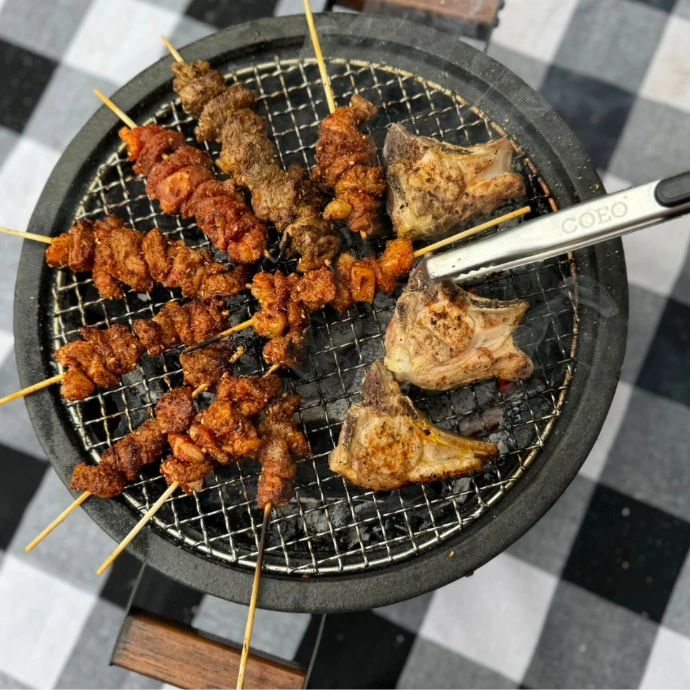
Yakitori are Japanese skewers traditionally cooked on a charcoal grill.
THE NECESSARY INGREDIENTS
To prepare authentic yakitori, use chicken thighs, spring onions, soy sauce, mirin, and some bamboo skewers.
PREPARE THE YAKITORI SAUCE
The tare sauce is made of soy sauce, mirin, and a touch of sugar. It is reduced over low heat to achieve a slightly syrupy texture.
SUCCEED IN COOKING ON A HIBACHI
The skewers should be turned regularly to achieve an even colour and perfectly controlled cooking.
HOW TO PREVENT YAKITORI FROM BURNING ON A HIBACHI?
Cooking yakitori requires good management of the heat produced by the charcoal. With a few simple gestures, it is possible to achieve tender, juicy skewers that are perfectly caramelised.
WAIT FOR THE COALS TO BE READY
Cooking should start when the coals are bright red and stable, without significant flames. A constant heat allows for even cooking and limits the risk of burning the food.
APPLY THE SAUCE AT THE END OF COOKING
The yakitori sauce contains natural sugars that caramelise quickly. To prevent it from burning, apply it only during the last few minutes of cooking.
TURN THE SKEWERS FREQUENTLY
Turn the yakitori every 30 to 60 seconds to achieve even cooking and a nice colour on each side.
LIMIT GREASE FLAMES
When flames appear, simply move the skewers to a cooler area of the grill to preserve the flavours and texture of the food.
FAVOUR BINCHOTAN CHARCOAL
Binchotan produces a stable and consistent heat that makes it easier to control cooking. It is the reference charcoal for Japanese barbecue enthusiasts.
FAQ ON HIBACHI AND SCHICHIRIN
WHAT IS A JAPANESE HIBACHI?
The Hibachi is a Japanese grill that allows for direct cooking over charcoal at high temperatures. It is appreciated for its simplicity, speed of cooking, and authenticity.
WHAT IS THE DIFFERENCE BETWEEN A HIBACHI AND A SCHICHIRIN?
The Schichirin is the traditional ceramic grill, while the term Hibachi is often used to refer to this type of Japanese barbecue as a whole.
WHY CHOOSE A CERAMIC GRILL?
Ceramics improve heat retention, reduce charcoal consumption, and promote even cooking of food.
WHAT IS THE BEST CHARCOAL FOR A HIBACHI?
Binchotan is considered the best charcoal for Japanese grills due to its high calorific power, long burning time, and low smoke emission.
WHAT FOODS CAN YOU COOK ON A HIBACHI?
The Hibachi allows for cooking meats, fish, seafood, vegetables, yakitori, yakiniku, and many Japanese specialties.
HOW TO SUCCESSFULLY MAKE HOMEMADE YAKITORI?
Use uniform pieces, turn the skewers frequently, and apply the sauce only at the end of cooking to achieve perfect caramelisation.
WHY DO MY YAKITORI BURN?
Excessive temperature, too large flames, or premature application of the sauce are the most common causes.
IS THE SCHICHIRIN SUITABLE FOR SMALL TERRACES?
Yes, its compact size makes it an excellent choice for small outdoor spaces while maintaining the performance of a true Japanese grill.
WHAT IS THE DIFFERENCE BETWEEN A HIBACHI AND A KAMADO?
The Hibachi is designed for direct charcoal cooking, while the Kamado has a lid that also allows for slow cooking, smoking, and roasting.